Since my sewing has been completely focused on skating costumes for others recently, I have very little to show, I thought I would continue my Skate Equipment review series so that I at least have *something* to talk about. My plan is to do a weekly skate-part review post until I have covered a majority of the skating equipment in reasonable depth. Last week I talked about wheels, so today’s post is the natural progression from there – today I will be talking about skate bearings.
*Disclaimer* I want to state that all of my reviews are opinions formed based on personal experience and are not meant to be an ultimate guide or reflect negatively on any of the companies or products I am discussing. I am only offering my opinions in the hope that someone might find my comments useful or offer their own suggestions in the comment section. Everything I have tested I have borrowed or bought myself – no sponsorships or anything like that. Like buying a high-end sewing machine, skate equipment needs to feel right to a skater, and what I like might not be the best for someone else. However, I have been skating a long time on a lot of different equipment, so I feel like I do have something valid to contribute to the discussion.
Like wheels, there are a number of different companies that sell skate bearings, and every skater seems to have their own preferences. I will admit up front I have a rather biased opinion and a very specific preference for bearings, so you may want to take my reviews with a grain of salt, although I will point out that I have come to my conclusions after many years of skating, so they weren’t come to randomly or without experience.
Skate bearings are comprised of ball bearings inside of a casing, usually with a protective cover of some sort. They come in 7mm and 8mm sizes – the 7mm size is most often used for artistic skates, where the 8mm bearings are used for skateboards and outdoor skates. You need two bearings for each skate wheel – a total of 16 bearings for one set of skates. Most bearings are given an ABEC rating, and many people assume a higher rating indicates a better skate bearing, which is not necessarily the case. The ABEC rating deals with Tolerances, but won’t indicate how smooth a bearing rolls, or how long it rolls bearing weight. Like durometers in wheels – ABEC ratings won’t necessarily help you pick a better bearing or choose the best bearing between different brands. It is better to test the bearings and decide for yourself.
Bearings, unlike skate wheels, can have a much longer lifespan if they are properly cared for and maintained. Skate wheels round, flat, wear down, and have to be replaced. If a skate bearing is cleaned (with acetone or alcohol), dried quickly (so as not to rust), and properly lubricated (ah, the debate over bearing lubricant is vast and varied – people have been known to use everything from WD40 to rifle lubricant to brand-name bearing lubes) then they can, in theory, last many, many years. Some people clean their bearings as often as every two weeks. I have to admit, I am very bad about cleaning my bearings, and whenever anyone else has cleaned them I notice a very sharp decrease in performance, even when compared to the dirty un-cleaned state. I recently acquired some Bones Speed cream lubricant and the Bones cleaning bottle system, and I plan to experiment with bearing cleaning in the near future. If/when I get around to it I shall do a how-to review post at that time. At this point when my bearings get old, I tend to replace them, but I am thinking/hoping that if I am a bit more proactive about my cleanings I can be a bit more cost-effective with my bearing habits in the future.
So, with that being said, let’s look at the options:
Bones
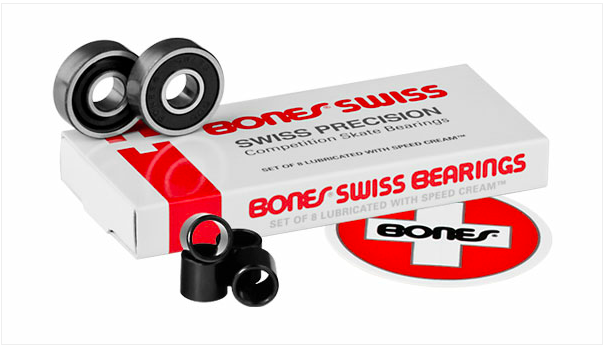
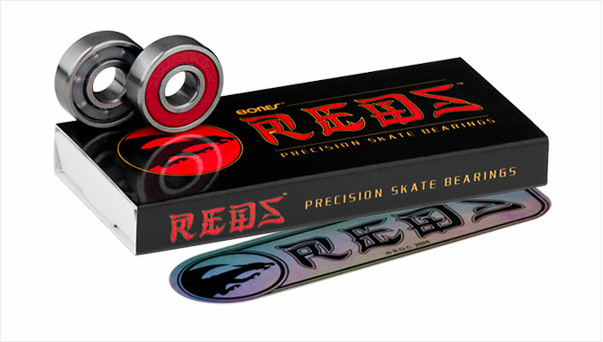 I will come out and say that, without a doubt, Bones bearings are the best skate bearings available today, by far. I have been skating on Bones almost since I started, and any time I try anything else I am disappointed. For years I skated on the classic Swiss Bones, but lately I have fallen in love with the newer Swiss Bones Labyrinth bearings, which have an extra protective shield to keep out dust and dirt. You can see a full list of their product line here. All of these bearings are made in the larger 8mm size for skate boarders, but most are also made in the 7mm size for roller skaters. I have tried the Bones Swiss (fabulous), the Bones Swiss Labyrinth (even more fabulous), and the Bones Reds. I will say that a few years ago I tried some of the Bones Reds (these are made in China as opposed to the higher priced Swiss bearings which are, clearly, made in Switzerland) and I was not impressed. Recently I was able to try a newer set of Reds and they were AMAZING. Very fast, very smooth. I think there have been some improvements made to the Reds line, and I would be confident in recommending these bearings as well as the Swiss bearings, though I will say that I do not have a good sense of how long the Reds last in comparison to the Swiss bearings. I have been known to wear the Swiss bearings for several years (at least in my figure skates) without a cleaning. They last forever – and the newer Labyrinth ones last even longer. I have been using some Labyrinth bearings for nearly a year, and they are just as silent as the day I put them on. Truly, I cannot say enough good things about these bearings. I will say I had the opportunity (once) to test out another skater’s set of ceramic bearings. They were nice, but I did not notice a drastic enough difference from my regular Bones Swiss to justify the extra expense (the ceramics are 2-3 times more expensive than the steel bearings). You can read about why the company shuns ABEC ratings here, and about how they have developed their products over the years here.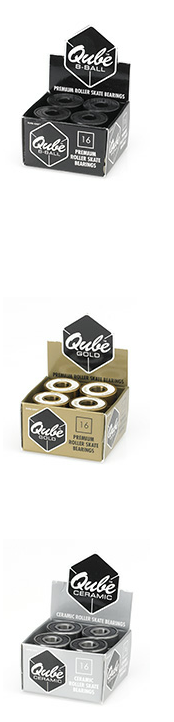
Others: There are various other bearing companies (such as Bevo, Kwik, BSB, etc) that offer bearings at various price points. I haven’t tried them, and I don’t know anyone who uses them. I do know someone who buys industrial bearings for $1 each and uses them in their freestyle skates because they seem to take a beating better than the Bones bearings. I have a set of these and while they are fine (better than the Qube bearings even) they don’t have the roll one would want in a dance or figure wheel. Also, because this is one of those things where “I know a guy who knows a guy” I can’t really point you in a specific direction because I don’t know the brand or where he gets them. I just know I have a set and I like to use them for resistance training because they are slow but not too slow.
 Doctor T Designs
this review was extremely helpful to me. I've been rolling on the carbon J bearings (7mm) since getting new skates a month ago and have really noticed how slow these bearings are. Hard work on figures that's for sure. Thought it was just me so very glad to read your comments about your experience of them being too.
LikeLike
I dug out my skates, I built in the early 80s and I do have Faffner German bearings in the skates still in perfect condition
LikeLike