I fell down the Kibbe style rabbit hole a few years ago when his Metamorphosis book from the 1980s was starting to make a resurgence amongst the internet style and fashion gurus. Of course, once the out of print book started hitting internet levels of fame, it was going for crazy bananas pricing on the secondary market. The internet being what it is, it is possible to find excerpts from the work online (or even some reproductions in full on certain internet archives), but as the book was starting to come back into the public consciousness, Kibbe internet groups started interacting with the author and it turns out that a lot of his philosophy had changed since the 1980s. This, of course, led to lots of fighting on the internet (as all things do) because it became a bit of what the author said vs. what was written in the book. Add to that, it seems that David Kibbe was largely getting fed up with a lot of the internet analysis of his original book (more on this in a bit), so he wrote a new book, David Kibbe’s Power of Style.
Normally I would just do a book review and leave it at that, but since I’ve already done so much deep diving on Kibbe’s previous work, I think a bit more of an analysis and discussion is in order. So we’ll start with a general review of the book on its own merits, then discuss some of the positive and negative changes compared to Metamorphosis, and I’ll assess where I’m feeling it leaves me after having read both the old book and the new book, as well as having followed a lot of internet stylists who utilize this system.
Book Review
Ok, so, I’m going to preface this by saying that I do think there are positives aspects to this book, and that on a personal level I feel that I ultimately “found myself” in this system after having read Power of Style which was not the case after having read Metamorphosis. However, I don’t know if I can call this a “good” book. After reading Power of Style, it really gave me the sense that Metamorphosis feels like Kibbe being edited for what a publisher thought would sell to the masses, and Power of Style very much feels like David Kibbe writing for himself. Which, on the one hand, good for him. On the other hand… were this Kibbe’s only style book, I don’t know that this book would really take off the way his first book has. In my review of Metamorphosis I described the language as flowery; in Power of Style it is downright baroque. He also goes on a lot of tangents that, while illustrative (and perhaps interesting if you’ve been following the whole evolution of the Kibbe system), would likely feel a bit out of nowhere to the average reader.
In terms of the contents of the book, the structure is in some ways similar to Metamorphosis. David starts with the philosophies and metaphysics of the system, moves on to how to find your Image Identity based on the way fabric would drape over your body structure, then goes on to discuss color systems, hair, and makeup. Finally he ends with few words about modern internet culture before bidding his readers adieu. Throughout the book he includes exercises and activities to help you understand his concepts and to guide you down a path of self discovery to land at a place of self love after going on this style journey. As with Metamorphosis, although the language is a bit flowery and definitely boarderline spiritual in a few places (though he delves a lot more into the metaphysics in this book), the overall sense is that he is trying to help you get past any feeling you have that you are not enough and find a place of joy in self acceptance through the steps outlined in the book. I think it was this original message that made his system so popular in the first place and I appreciate that it’s still a strong message in this book as well.
He does allow himself to go on random tangents and repeat himself at parts. I think the repetition is for emphasis, but often if feels unnecessary because there isn’t a lot of of extra substance between the parts telling you to slow down and follow the process. I do appreciate that this is a journey and that Kibbe really wants you to work through the exercises sequentially, and perhaps had I come to this book completely new to his system I would have, but I did often feel like there were parts where there was a lot of extra text without adding a ton of substance. Of course, this wasn’t everywhere, but I do think that’s what made it feel a bit annoying when I did get to those sections. It was almost like the text was going wait for it…. wait for it… wait for it… ok, I’ll tell you. But there wasn’t that much added information in the wait for it segments that we couldn’t have just gotten to the meat of the content, especially when that content itself was going to be described in triplicate. As I said above, this book really feels like it was written by David, for David (and also for his wife Susan), but I think a tiny bit more input from an editor could have helped with the flow a bit more.
There are also several spots in the book where Kibbe goes on a bit of a rant because the world hasn’t quite caught up to his system in the way that he had been using it more recently. Though I will admit that two of these (the “Quiz Rant” and the “Fruit Rant”) were actually fairly fun to read. I had seen a rumor that Kibbe didn’t want to include the quiz in Metamorphosis that is supposed to help determine your Image Identity. The Quiz Rant in this book was pure gold, pointing out that you have to study for a quiz, and the only way to do well on a quiz is to already know the answers, which goes entirely against the ethos of self discovery that is supposed to happen on this style journey. It was very much a “tell me that your editor forced you to include a quiz in your first book without telling me that your editor forced you to include a quiz in your first book” moment. I think this also stems very much from the idea that Kibbe is trying to get style to be an overall image or presentation, and the quiz very much had everyone (even me!) wondering how sharp their nose was or if they had hands and feet that were small or wide. I definitely get how doing a dissective self-analysis sort of flies in the face of the rest of the philosophy of accepting yourself as a whole. So in Kibbe’s universe ding-dong the wicked quiz is dead, and to that I think a lot of people would say, good riddance. It was confusing, I think it let a lot of people down rabbit holes, and, to an extent, I agree with Kibbe that if you don’t already know “the answer” to the quiz it won’t lead you to the right ID, and that will result in spinning wheels and frustration.
What I will call the “Fruit Rant” isn’t really as important since it doesn’t foundationally change the way the system is applied, but there are several bolded quotes with things like “You are not a kumquat!” that I think I’ll need to find a way to work into everyday conversation, because they are just delightful. I think Kibbe’s opinion that he is not trying to “correct” the body or make everyone look like an hourglass figure was clear even back in the 80s, but his frustration with systems that use fruit or letters or other stand-ins for body shape is emphasized in Power of Style. This was one of the reasons I gravitated toward this system in the first place (it wasn’t about using clothes to “fix a problem”, it was about using style to create something harmonious and beautiful), and he definitely leans into that perspective hard in this book.
The third notable rant comes near the end of the book, and is about, what else, but the internet. It kind of gives a pouty vibe that people have been “doing it wrong” because we’ve all been stuck on what was written in Metamorphosis in the 1980s. It cautions against following internet analysts, crowdsourcing, and “trying on” the Kibbe “types” (he really hates when you say “types”) to find your ID. On the one hand, I get it. The man has made his name and income selling people the experience of going through a style journey and he has a very particular method and way he likes to present things. On the other hand… once a thing exists, people are going to do weird things to it on the internet. They are going to play with the concept. They are going to come at it from a way that makes sense to them. If they are content creators, they are going to monetize the shit out of it and thank today’s sponsor. This is just the world we live in. Even if it’s the “wrong” method, if it’s entertaining and they can post it to YouTube, they are going to do it. So, on the one hand, I get where Kibbe is frustrated because there are a lot of people spreading what from his viewpoint is misinformation on this system. And living at the dawn of what I can only assume historians will call the misinformation age, I do get the concern. However, we are talking about style here, not like, I don’t know, infectious disease. Let people live a little, have some fun, and explore things in their own way.
Interestingly, it has been difficult to find many recent interviews with David (prior to the book release; he seems to be going on a bit more of a press tour now so there seems to be more interviews available), and most of the “word of Kibbe” seemed to come through a few posts on the Strictly Kibbe Facebook Group, but Gabrielle Aruda managed to record a full hour of discussion about the new book and post it on YouTube. Discussions about some of the book rants and main themes come up (spoiler alert?), but they honestly sound a lot more thoughtful from a verbal interview (like, oh these poor people stuck in the 80s, I must help them!) rather than the “you’re all doing it wrong” tone that comes across in the book.
I think if you listen to the interview first it actually might help with reading the book. Actually, I might almost say that listening to the interview first should be mandatory. He writes the way he speaks; I just find that it’s easier to comprehend when listening than reading, because it has this cadence of a flowing stream of consciousness that is much harder to parse in written text than as spoken word. But if you can find the rhythm of his speech patterns and then try to read the book in his voice it will likely go much better than if you don’t. As someone who rambles on a blog, I do understand the struggle of trying to inject your own voice, but with all due respect, if you can’t imaging someone saying it to you vocally, it’s really hard to not get lost in the ramble at a few points in the book.
Changes Since the 80s
The system has evolved quite a bit since the publication of Metamorphosis in the 1980s. Some of these changes are fundamental to how the IDs are assigned, how makeup should be done, and the clothing recommendations. However, some of these “changes” aren’t really changes in the system so much as a change in the audience and their access to information, which has resulted in some much needed updates to the list of celebrity icons and transformations shown in the book.
Probably the biggest change in the system between Metamorphosis and Power of Style is the classification of the Image Identities. In Metamorphsis there were thirteen; five main IDs and one or two sub-IDs for each. This had been floated on the internet for a while, but in this book it is confirmed that the categories of Natural, Classic, and Gamine have been removed, and there are only two options for each of the five main Archetypes. I will say I sort of understand how Kibbe got to this by changing the method of classification between the first book and the second (see above for the rant on the quiz), but I will also say I do feel a bit bad for people who really strongly felt they fit into the main categories and felt a bit at odds with trying to fit in somewhere else.
| Image Identity | Metamorphosis Phrase | Power of Style Phrase |
|---|---|---|
| Dramatic | Regal Lady | The Deco Dynamo |
| Soft Dramatic | Diva Chic | The Diva |
| Flamboyant Natural | Free Spirit Chic | The Nonchalant Showstopper |
| Natural | Girl Next Door Chic | N/A |
| Soft Natural | Fresh and Sensual Lady | The Sassy Covergirl |
| Dramatic Classic | Tailored Chic | Haute Powerhouse |
| Classic | Sophisticated Lady | N/A |
| Soft Classic | Graceful Lady | Haute Elégante |
| Flamboyant Gamine | Sassy Chic | Très Chic Iconoclast |
| Gamine | Piquant Chic | N/A |
| Soft Gamine | Spitfire Chic | Très Chic Irresistible Spitfire |
| Theatrical Romantic | Femme Fatale Chic | La Femme Fatale |
| Romantic | Dreamspinner | La Belle |
Obviously, some of these descriptive phrases remain quite similar between the two books (SD as Divas, TR as Femme Fatale, SG as a Spitfire). However, some of the phrases that seem to have mystified the more modern audience (looking at you “Dreamspinner” and “Fresh and Sensual Lady”) have been updated, I think largely for the better. Though I will admit, I can imagine using “fresh and sensual” to avoid the lawsuits for saying “easy, breezy, beautiful…”; with the “covergirl” description I kind of get it now. I still feel like the Romantics are still kind of left in this slightly nebulous zone compared to the other descriptive phrases, but overall I think the updates are generally an improvement in terms of creating a mental image of the overall vibe of the IDs.
As part of this shift, another major change is the process for finding your ID. Previously it was found using the aforementioned rant-inducing quiz, which is now dead to us. The updated method is to really look at the overall structure of the body. As a sewing blogger, I actually feel like the new method is so much easier because he describes it as draping a lightweight fabric over your shoulders and seeing what the primary and secondary characteristics are. The primary can only be one of two options: vertical or curved. He also throws in the caveat that if you are over 5’6″ you are automatically vertical dominant because you just need more length of cloth to cover your body. In Metamorphosis that 5’6″ – 5’8″ range was really nebulous because there was a lot of IDs that had upper limits on height, but it didn’t seem super strict, whereas now there is an absolute point at which being a certain height automatically gives vertical as a first characteristic. It’s probably a bit trickier if you are under that height, because you have to really look for vertical or curved lines, which might not be completely intuitive if you are one of the types that is a mix or blend of both, especially since there aren’t any height minimums on the IDs, just height maximums. Anyway, once you have your first characteristic (vertical or curve) you find your second characteristic, which has quite a few more options (curve, double curve, petite, broad, etc.). Depending on the combination of the first and second characteristic, you locate your Image Identity.
On the whole, I found this process much easier than the quiz, though being over 5’6″ it streamlined things a lot since I didn’t have to wrestle with being curve dominant as a first characteristic. It does restrict the ID options quite a bit for the taller people (basically Dramatic, Soft Dramatic, and Flamboyant Natural are the only possibilities). I do think this means there are probably a lot more Soft Dramatics in the world now that everyone who is over 5’6″ and has curves only has one place to land, but, honestly, nothing wrong with that. I also appreciated that “petite” was a secondary characteristic; I feel like a lot of the “delicate” wording that was used for Romantics in the first book was a bit confusing when comparing between Romantic and Soft Gamine, but the difference is a lot more clear now that extreme curviness is the characteristic of the Romantic, where as petiteness is the characteristic for the Soft Gamine. So, overall, I think this change to finding your ID is a big improvement compared to how the theory was presented in Metamorphosis, and will likely result in people finding their IDs with a lot more success off the bat, rather than wandering around trying different things before getting frustrated and giving up.
The next major change, and probably the most controversial one, is that Kibbe is much less prescriptive about clothing recommendations in this book. He justifies this by giving a history of clothing, and showing how silhouettes were largely created by the construction of clothes throughout history, up through the 1980s. Once the prevalence of stretch clothes took over in the mid-1990s and early 2000s, Kibbe argues that describing the types of clothes that will work for the IDs doesn’t matter anymore because, essentially, the clothes don’t make the silhouette anymore, the body does. Which, as someone who was a teen in the early 2000s, I would agree with (cue Millennial body issues and jokes about low rise jeans). Honestly, I would also recommend this amazing video from Abby Cox about the history of pockets, because it goes through pretty much the same argument, though with the emphasis on pockets, rather than on the modern silhouette as a whole.
Anyway, back to Kibbe. So, in this book he really doesn’t give much information about how any of the IDs should dress. Each of the 10 IDs get a basic description of the Yin/Yang Balance, the Line, 1-2 sentences about the overall goal of the silhouette, one celebrity Icon for the ID, and a few additional celebrity exemplars. There are also three illustrations for each ID showcasing different outfits, and one style transformation of a real person for each ID. And that’s pretty much it. The detailed descriptions of clothes, accessories, and jewelry are gone. So anyone hoping for an updated list of wardrobe pieces, more modern examples of outfits or clothing descriptions or perhaps even just an affordable way to access the information that was originally published in Metamorphosis is kind of out of luck, because this is not what this book is about. Not that anyone was really looking for an updated recommendation on hosiery, but I think the idea that most of the people who bought the book were expecting some additional guidance on shopping is not too far of an assumption.
I will take a moment to point out here that criticism of his previous work includes the lack of diversity of his celebrity examples and style makeovers. I’m happy to say that while many of his Hollywood Icons are the same as in his previous work, there is much more diversity in his list of Exemplars. He also has a section of the book that showcases the style makeovers, and this is quite a diverse group of women, with considerations not just for ethnicity, but also for age and size of the model. Even the illustrations for each type place additional emphasis on diversity, so it was nice to see that this issue had not gone unnoticed and has been updated in the new book. I do think that this is one way in which the internet has actually helped, because now if we don’t know who a celebrity is we can Google them, locate their work on IMDB, and likely fall down quite a deep Pinterest rabbit hole, whereas it would have been quite a bit more difficult to find this sort of information back in the 80s. I’m not saying it would have been impossible, but definitely not the same level of ease as Googling celebrity style images on a phone.
The color system hasn’t really been updated much since the 1980s, though I believe in Metamorphosis Kibbe was into the four season system, whereas now he refers to things like “Dusty Summer” and “Vivid Winter”. I don’t think he follows the Sci/Art 12 season approach to color, but it seems similar in that there are subtypes in each of the four main types (though he doesn’t call them subtypes). He goes through a few exercises to help you locate your best color season, but I do think that while this section is given quite a bit of length, it is also ironically where the book is the most lacking. He admits that finding your colors is likely the hardest part of a DIY journey, but only includes color swatches and images for the four base seasons and not the sub-seasons. It’s a bit hard to understand a discussion of colors without seeing actual color, and I think there will be much debate about the color descriptions here for the really zealous Kibbe followers who are trying to unlock the truth of every written word.
I would argue that while the sections on makeup and hair are emphasized as being important for the head-to-toe look, it sort of feels like Kibbe ran out of steam in these sections, once he got past the major segments about the ID and color. Or maybe that was just how I was feeling reading it. Kibbe does touch on hair and makeup in Metamorphosis, and I felt like it was a lot more prescriptive for the different IDs and also more of its time. He had different application recommendations based on type and on color season. Now he has very general descriptions about the hair styles for each ID, but similar to the silhouette it is a one-sentence overview at best. The makeup colors are still recommended by season, but no longer are the techniques different for the different IDs. This was probably the area where he could have had the most changes in terms of updating recommendations for the modern day, but instead he defaults to the running theme of the less you say, the longer its true. Kibbe also claims you can finish a makeup look in 5 minutes, but then goes on to recommend 12 different face products for the makeup application. I felt like both of these sections could have been a bit more helpful, in that by this point in the book we feel like we’ve found an Image Identity and Color Season, but now the recommendations for hair and makeup feel very general for everyone.
So, as you can see, there have been quite a few changes since the 1980s. Some updates (such as the increased diversity of examples) is a welcome update for the modern era. Some (such as the more streamlined examples of outfits for each ID) have been met with mixed reviews, if Amazon and Goodreads are anything to go by. I think a lot of people were ready to approach Power of Style as an updated Metamorphosis, but it’s really not that. The roots of the philosophy are the same, but there have definitely been some significant changes to the way the material is presented between the publications of the two books.
My Thoughts and Personal Style Journey
So, when I first came to Kibbe several years ago, the importance of height was a bit less strict and the way you found your ID was through the quiz that was included in the Metamorphosis book. I started off thinking I was a Soft Classic, but that really didn’t feel right, so I abandoned that thought pretty quickly. I ended up thinking I was a Soft Natural, but in my recent post on Kitchener Essences I eluded to the fact that I still felt like something wasn’t working for me in terms of the Soft Natural ID. And, I know we aren’t supposed to consider individual elements or style gurus off the internet, but when all of them recommend “mom jeans” for Soft Naturals and I have never, nor will I ever, look good in mom jeans, it maybe should have clued me in that something about my ID might be off. Cue the chapter on finding your Image Identity in Power of Style. The revelation that if you are over 5’6″ (I’m 5’7″) meant you had to have vertical as a dominant trait meant there was only one Image Identity I could be – Soft Dramatic. It was definitely one of those moments where I was like… “Oh? Oh! Ohhhhhhhhhhhhhh.” Honestly, it kind of explains a lot. And it really emphasizes my conclusions from my Kitchener post that I need elongation, but soft draping and not as stiff or structured of lines. It also explains why I was feeling a lot better about Dramatic-ish looks over Natural-ish looks, when I thought I was in a Natural category. And when I look back at the same images from a Kibbe lens of trying to see which follow the recommendations for Soft Dramatic, it absolutely aligns between the recommendations and what I’ve generally found to be my most successful outfits. Even my most recent dress would definitely fall into the now outdated “Diva Chic” description. I think understanding the ID in terms of what kind of silhouettes are possible to create on a body as compared to a dissection of how all of the different body parts interact is such a game changer in applying the IDs in real life. I even went back and re-plotted the photos of my sewing projects over the years into the Kibbe IDs. My favorites are definitely in the Soft Dramatic category, which I know is a bit of confirmation bias, but it’s nice that the different systems sort of agree on this point.
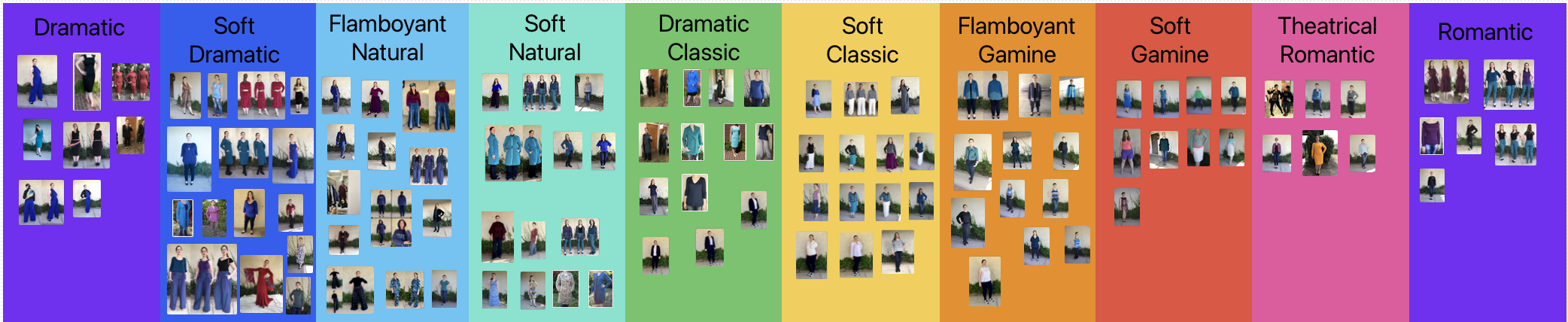
The funny thing is that going back to Kibbe’s discussion about resistance to an ID (from his first book) was that I had immediately ruled out a Soft Dramatic previously because I don’t consider my underlying bone structure to be particularly Dramatic (I have fairly thick bones), but I also have relatively small hands and feet for my overall size. So when I was considering my body and where it fit in the descriptions, I couldn’t see the relationship to Soft Dramatic, and I thought I was hitting a lot of those “Will not have/be” points, so I never even considered it for myself. That, and I think there was some part of me that wasn’t allowing myself to be “The Diva.” I know I had a bit of a fangirl crush on the Soft Dramatic ID and some of the over the top styles, but in a “I’m not cool enough for that ID” kind of a way. Not having to analyze how pointy my nose was (it was really the only feature I ever considered as being “Dramatic” from the quiz days) and being able to really have only one option for an ID made it so easy, and really let me just accept my inner Diva as my actual Image Identity. (My innie being a Diva… any Severance fans out there? Maybe this moment was sort of like a style reintegration…)
Now, in terms of practical application, I will say that the newer book having only one vague description of how a Soft Dramatic should dress: “You need both a strong vertical (long, unbroken) along with a soft, curved or draped outline. When one is looking at you, the eye needs to travel in one unbroken vertical downward but should also have curve or drape, especially on top. If there is flow, it still needs to be elongated.” It does feel, as Gabrielle Arruda said in the interview, a little bit like “the training wheels have come off.” I will say that I think the more vague descriptions and emphasis towards making a full outfit rather than looking at individual pieces does make sense, however, I still think the descriptions from the 80s were really helpful in training the eye for how to see those things. I also think, as sewists, we have access to a lot of fabric, materials, and techniques that, as Kibbe points out, have generally been lost to the RTW market. We actually can tailor clothes to make shapes, if we wanted to. So I think the argument that you can either have skin-tight stretch clothes or very loose baggy clothes and you have to figure out how to work with them to get a silhouette that works for your body is not entirely correct, though I will also concede that if you aren’t looking at vintage patterns there is some limitation in the market right now, since modern patterns tend to mimic modern styles.
All that being said, I think I need to re-evaluate some of my sewing plans, but, honestly, I’m also trying to embrace Kibbe’s new philosophy that anyone can wear anything, and it’s more about the overall outfit. I still think his stated philosophy contradicts a lot of what he’s said and sort of the whole ethos of finding an ID, especially because we all know we’ve worn things that “don’t work” and are largely here because we are trying to figure out why, and how to avoid wasting time and money on that in the future. I’ve been going through my patterns again and I’m definitely finding some hidden gems that have been added to my list because they are perfect for creating the Soft Dramatic silhouette, though I think there’s also a lot of cross-over between what a Soft Natural and a Soft Dramatic would look good in (I agree with Kibbe that a garment doesn’t belong to an ID, but I do think some garments will work to create the desired silhouette better than others), so I’ve still got a lot of patterns that made it to my short list before that are still staying there. But maybe what I need to do is make a few “going to work” outfits, some “going to the airport” outfits, and some “work from home on Zoom” outfits to really feel like I don’t just have pieces but a full wardrobe. I do want to consider my approaches to applications of print, color, accessories, etc. in a bit more detail, but I’m motivated to get back to wardrobe planning now that my job situation seems a bit more clear in terms of the amount of remote vs. in-person work, and it’s also a bit more obvious to me what sort of outfits I would like to have and where my current wardrobe is falling a bit short. I will admit I’ve gone back to my own post on Soft Dramatic more than a few times to look at what was previously written in Metamorphosis. I know we are supposed to leave the past behind, but, honestly, the information was kind of helpful. That’s what made this system as popular as it is today.
So, on a personal level, David Kibbe’s Power of Style has really helped me find myself in this system and finally feel like I am done searching for “the answer” and that I can really comfortably start applying the principles I had been searching for when I started writing my Sew Your Kibbe series several years ago. I had discussed this at the time, but since it’s been a while I think it’s worth re-iterating here, that my entire goal with this was just to help whittle down the many, many options in my pattern stash to really help me make the most of my sewing time. I’m often intrigued by shiny new things or making something that will teach me a new technique, or be part of a fun internet challenge, but this led to a lot of clothes and no outfits. Of course, I don’t think anyone has to dress a certain way or even apply any of these systems if they don’t want to, but I do think learning about these systems is fun, and I also think it is helpful to be able to have some guidance on narrowing down all of the options that are out there – because there’s a lot! I also feel like deep diving into this system has helped me re-train my eye and how I look at patterns and fabrics, and it’s definitely helped me purchase patterns with more intent towards sewing them, rather than buying them “just in case” I might have the whim to sew them someday. And possibly most importantly it’s done what Kibbe most intends, which is for me to accept myself and find joy in that, rather than constantly looking for flaws to be corrected.
Conclusion
So, where does that leave me in terms of a final book review? Obviously, I had some issues with the book just in terms of read-ability. I also don’t think this is the books that many people thought they would be getting, at least in terms of the information about the IDs, color seasons, or style recommendations. I know this will likely draw the ire of the most ardent of Kibbe’s followers, but if this book was intended for the masses, I really feel like it could have used a bit more editing. I also think that the inspirational (perhaps aspirational?) drawings for each of the Image Identities may feel a bit over the top for the average reader and may turn off people from embracing the idea of the Image Identity, because there is still a level of over the top Hollywood glamour baked into the base layer of the system. Illustrations for casual looks would have been much appreciated, and many of the other sections (such as the color section) could have benefited from more pictures and examples too. Honestly, I think the whole book could have benefited from more pictures and examples. I do think the exercises are interesting and I plan to do them, just to see if it changes my perspective, but, honestly, I think they would likely be most useful for someone who hasn’t been thinking about style or color systems at all, whereas for me I think it might be helpful to just edit down my ideas.
I also think that some of the ranty bits of the book will likely leave some readers (who didn’t bounce after the very metaphysical beginning of the book) with a bit of a bad taste. I mean, maybe not the kumquat rant, because that’s just fun, but having an entire section of the book being dedicated to the myths of the internet places as much emphasis on that topic as on hair styles. I think Kibbe’s goal is to not come across as being too overbearing, too prescriptive, or too close minded. However, I feel like it almost goes too far the other way, where the writing comes across as being afraid of sharing too much, having the writing go out of date, or having the writing be mis-interpreted in the way he felt Metamorphosis has been on the internet, and as being the only source of truth when it comes to this system. In the interview he discusses how the recommendations in Metamorphosis are out of date, yet plenty of style analysts and bloggers have been able to interpret his writing for the modern age. And, honestly, since both of his books are mostly writing with only a few pictures, much of what he says is largely left up to interpretation anyway. Ultimately, it feels like he is trying to keep things too close to the vest, so that his work can never go out of style, but then he isn’t really making a point or even sharing anything at all, and that’s where this book feels a bit hollow. Like we know there should be more. The book hints that there is more. But, despite all of the writing, there isn’t actually more.
Obviously there are some updates to the system in this book that I found helpful. I appreciate the increased diversity of examples and I found the method for finding an ID to be much easier. Honestly, if nothing else, the one chart that simplifies how to find an Image Identity might have been worth it. On a personal level I feel like Power of Style filled in some of the missing pieces, and helped me understand the system better. However, despite this, I still find myself going back and looking at my own posts about the recommendations from Metamorphosis because I find that the more direct examples of the types of shirts, pants, and dresses that will create the silhouette is helpful in practically applying this system. I don’t know; maybe I still need the training wheels. Or maybe I don’t but I just like looking at the pictures and imaging the possibilities. With style being a visual medium, it’s, surprise, helpful to actually have visuals.
Overall I think people who came to Power of Style looking for an in-print, less expensive, and slightly updated version of Metamorphosis will be disappointed. This book is not going to provide you with a lot of examples for how to create the perfect outfit, help you find useful key terms for style searches, or how to perfectly quaff your hair. It may help clarify the system if you found the information available from Metamorphosis confusing, and I think it has some interesting exercises if you have never given much thought to your style at all. I do think the underlying message of positivity that brought me to Kibbe’s work in the first place is still there, but I don’t know that I would have been nearly as interested had I come to the system through Power of Style as compared to learning about the system as presented in Metamorphosis. So, who is this book for? Kibbe and his die-hard fans, honestly. I would like to say that it’s worth reading in a general sense, but I really think that depends on the individual reader and what you are hoping to get out of it.
If this wasn’t enough discussion on the book for you, I also found some more book reviews on YouTube while I was editing this post (so I watched them after I wrote my review). This first review is quite spicy and has a lot of critiques of the book that I quite agree with, and is possibly a bit more coherent than this rambling blog post:
And here is a review that does more of a flip through and works on the exercises, so it’s more focused on the actual contents of the book and not as much the overall impression of the book, in case you were still debating buying it:
I guess, to leave off, it sort of becomes a question of where I’m going from here. I honestly think I’m finally satisfied with the Kibbe thing, in that I know where I fit, and I feel like I understand how to achieve that sort of style. I will try the exercises, and maybe create a vision board that I can use for wardrobe planning. I am going to try to create Soft Dramatic silhouettes and see how that goes. I’ll probably even keep watching the internet style gurus who talk about his system because I enjoy them and their interpretations of his work, and their discussions about style in general. But I think I’ve gotten what I can from his work on an intellectual level, and I can really focus more on a practical application at this point. I won’t say that I’m never going to write about Kibbe again, but I don’t think the new book has inspired me to return to posting about the system on a regular basis. So, onwards to new adventures!
 Doctor T Designs
Well I’m only 5′ 5″ but I was a Natural….. I do still have Metamorphosis but don’t know if buying this new book book would give me any meaningful new insight in what to actually wear.
LikeLiked by 1 person
I sort of doubt it…. It might give you some vision boarding exercises but you already make amazing collections so I can’t actually see that there is much benefit from this book for you since you are already comfortable in your style. Maybe see if you can get it from a Library if you are curious, but honestly I would say save your money 😬
LikeLike
Thank you for such a detailed review! I found Kibbe through your blog and found it tremendously inspiring; perhaps because I fit so unambiguously into a particular style ID so there was no confusion. I love the fact that it’s all about celebrating individual bodies. So much style advice purports to do that but when you dig into it it’s still all about correcting flaws.
I’m disappointed to hear that he hasn’t updated the garment recommendations as those were so helpful.
LikeLiked by 1 person
Argh that posted before I’d finished…anyway I think I might buy a copy of this even though it sounds a bit disappointing because I’ve got so much from his system that I’d like to give something back.
And yes, now you say Soft Dramatic I see it. You rock a cowl neck.
LikeLiked by 1 person
Thanks! I think it was the wide legged pants that tipped me off… I like them because they are comfortable but it just wasn’t working as part of an overall outfit.
And I do think the book could be good if you want to work through the exercises to vision board and go through the whole process, even if you know your ID. I just know a lot of people expected an updated Metamorphosis and this book really isn’t that.
LikeLiked by 1 person
Don’t stop blogging. So few sewists (autocorrects to sexists) still do. I am a beginner and I need blogs. For instance, I just read your review of Burda Urban Ikat Sleeveless Dress = 02-2013-114. I worked on making a wearable muslin today: cannot for the life of me figure out that drape at the neckline!
LikeLike
I feel like the new book is more about how to have a successful shopping trip than actually telling you what to wear. My understanding is that he is recommending you go shopping for a particular head-to-toe outfit for a specific occasion. When you get to the store, eliminate everything that doesn’t fit your occasion and your color season. Try on everything else with an open mind. Buy one complete head-to-toe outfit that day.
I can see how using that method would create a creative yet cohesive wardrobe, but it’s not very applicable to home sewists.
LikeLiked by 1 person
what a comprehensive review! It sounds like an editor protected DK against his worst instincts! Fwiw: over the years I’ve seen you sew many a fetching SD garment, and you look great in them!
LikeLike