Although I have been really enjoying my recent projects with the self draft bra band with the Cashmerette Willowdale cups, I wanted to branch out and try some new patterns, just to have options and variety in my pattern library. I’ve been testing a few new brands, and it’s been really interesting to compare the differences between similar styles from different brands.

One of the patterns I have been working on is the Rubie’s Sahaara bra pattern, but this is a wireless bra that is unlike my now TNT wired bra frame, so it is taking quite a bit more effort to fit. I think I’m happy with the band fit, but I’m on my third iteration of adjusting the cup. I’m not quite ready to make this pattern, but I think I’m getting close though.

In the meantime I’ve also started working on some alternative cup patterns that will work in my self-drafted frame. I’ve been really obsessed with the idea of making a vertical seamed cup because I think they are really pretty, and I was torn between trying the AFI Atelier Exquisite pattern and the B, Wear Angie’s Twin pattern. Both of these companies are new to me, and the pattern reviews for these patterns are a bit mixed. I had a suspicion that the B, Wear pattern might be a better fit for me, but again I was curious, so I decided to do a head to head matchup of these patterns. The styles are very similar, so I figured that a direct comparison would be very illustrative about the drafting differences the brands, and possibly help me narrow down future pattern purchases when different brands offered similar styles.

There are some slight differences between these pattern designs; the AFI Exquisite has the strap extension coming up from the power bar, whereas the B, Wear Angie’s Twin has you optionally draft it split between the outer two cup pieces. The bigger difference is between how these patterns are drafted though. The AFI Atelier patterns seem to follow a pretty standard sizing, though they do seem to follow the method of adding 4″ to the underbust measurement to get the band size. Most of their patterns (including the Exquisite) come in four size packages which are labeled for EU, UK, and US sizing. Per the US size from the AFI size calculator, I started with a 42E and adjusted the cups to match my 44 Vertical wire line in my self-drafted frame. Conversely, the B, Wear patterns have a very unusual sizing compared to any of the other brands I’ve tried. The band sizing follows the EU standard of using centimeters, and without adding any length so my 36″ band corresponded best to a 90, which visually matched up pretty well. However, where most patterns follow a standard cup sizing where each cup letter is 1″ difference between either the full bust and the chest or the full bust and the underbust, starting with a 1″ = A, 2″ = B, etc., the B, Wear Patterns actually use the assumption of a much more projected shape, with 4″ = A, 5″ = B, etc. Some of their patterns come in four size packs, and others in three size packs. The Angie’s Twin is one that comes with four size options, so I chose the 90-105 A-E size range to start with. One thing I love about the B, Wear patterns is that all of the sizes are on the same papers, so you can see all of the size options for a given band size with only printing out a few pieces of paper, instead of printing out 3 or 4 copies of the whole pattern as I’ve been having to do with all of the other patterns that insist on having a single size per PDF page. Anyway, for the Angie’s Twin I blended the 90A wire line with the 90E cup length and width to get my starting pattern. I wish the 90F was also included in this pattern as the 90A/90F blend would have probably been a better starting point, but it didn’t seem worth buying another pattern for just one size up. Some of B, Wear’s newer patterns have the size breakdown a bit different, which I wish was how they also split up the Angie’s Twin, but this was good enough.
After tracing out my patterns and adjusting each of them to fit my custom band’s wire line, comparing the pattern pieces everything looked pretty equivalent in terms of depth and volume, though the pieces themselves had a slightly different curvature. I decided to make a paper mock-up, just to see if I could get a sense of what the patterns were going to look like. I was honestly a bit shocked by the results.


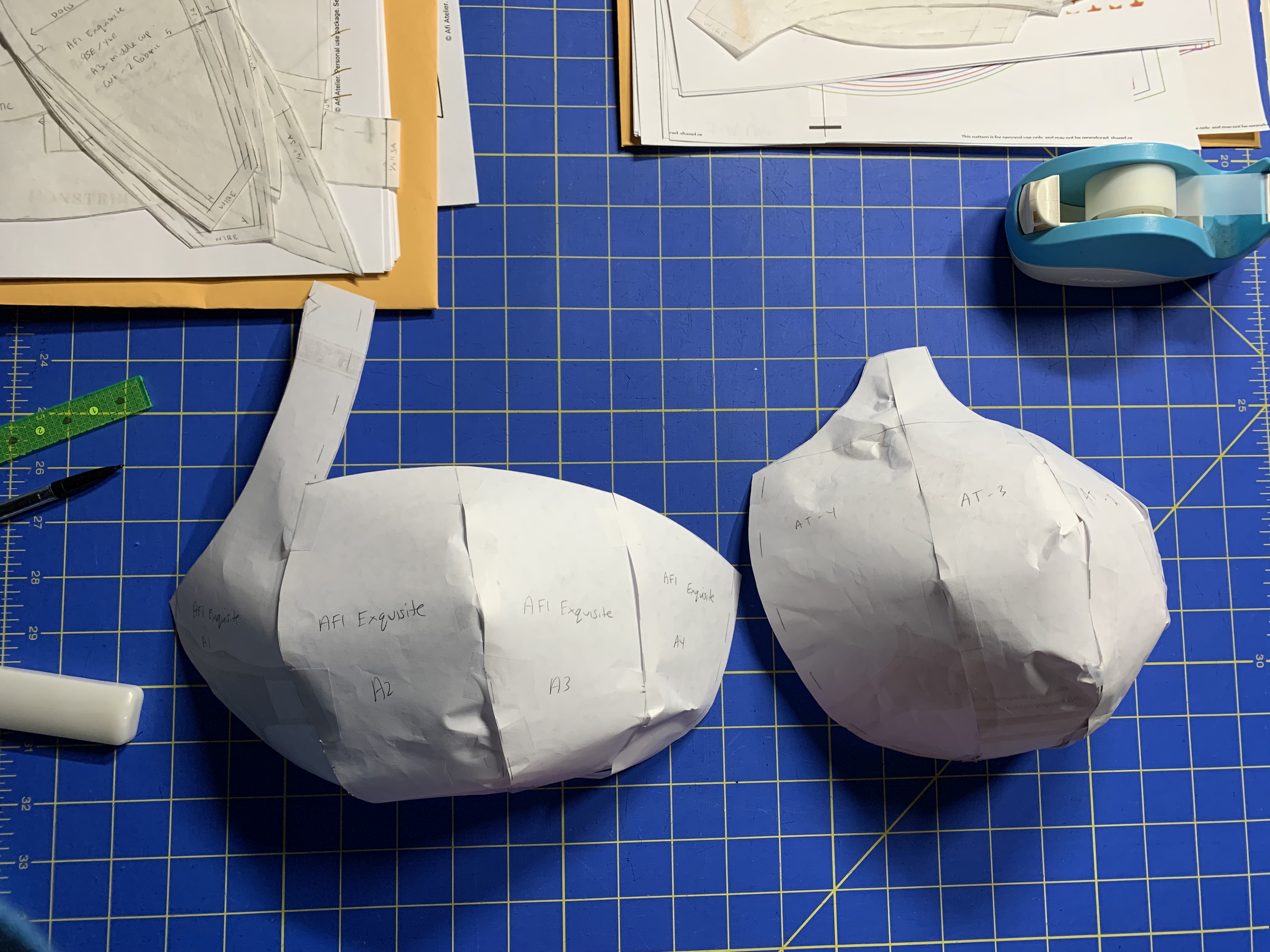
The differences between these two cup shapes is remarkable! The AFI Exquisite is very wide and flat and the B, Wear Angie’s Twin is very narrow and projected, even though each is fit to the same wire line. I pulled out the Willowdale paper cup I had made previously for another comparison:
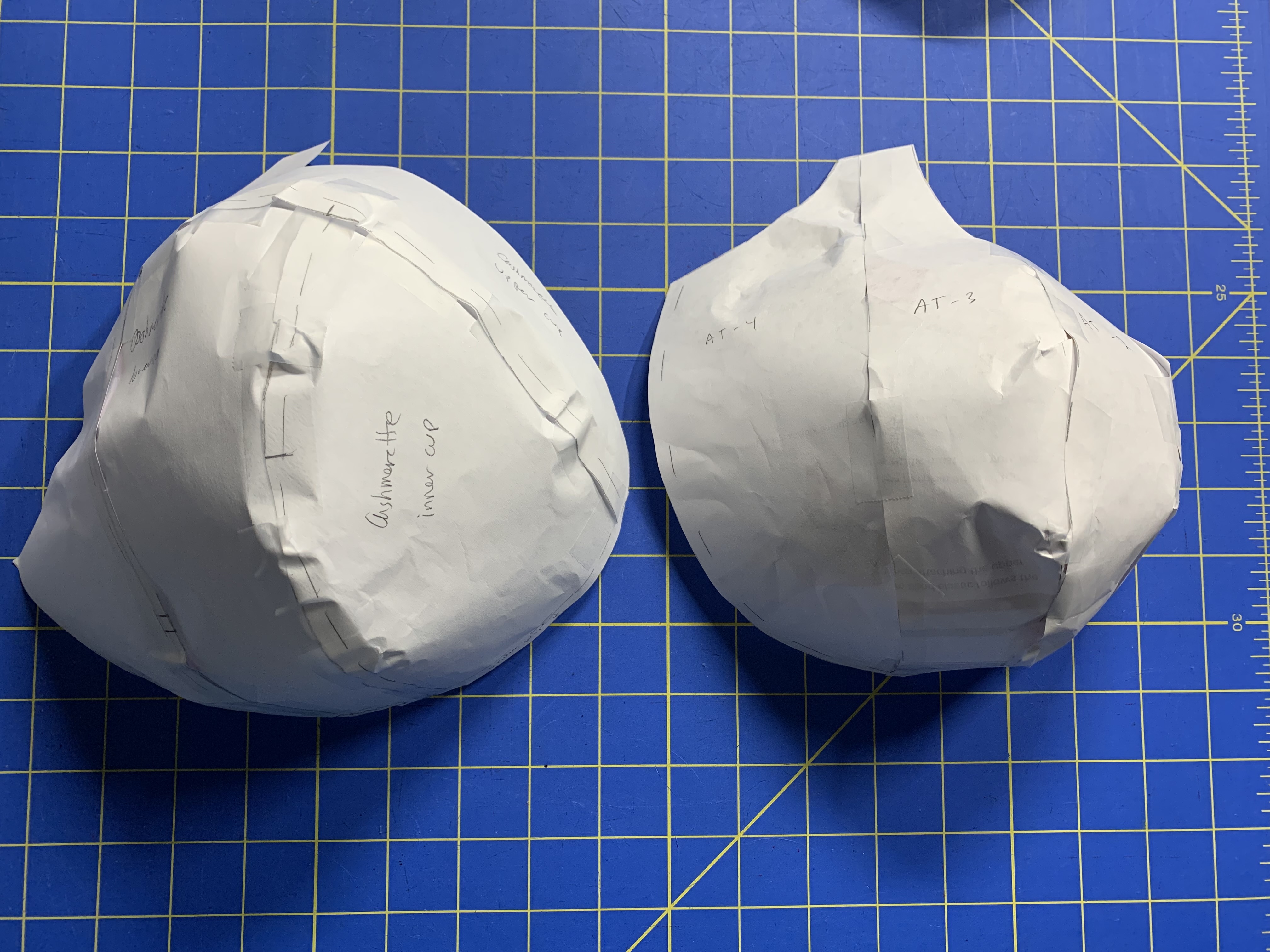

The B, Wear is a bit smaller than my Willowdale pattern, but it is honestly really similar in total volume, and also in the roundness of the shape, which is something I really liked about the Willowdale pattern. This was encouraging, so I figured I would move on to testing fabric cups. Although I suspected at this point that the B, Wear was going to be the winner for me, I thought I would still test each pattern, just to see. The Exquisite does appear to be more of a lower cut balconette style, so I thought it might be possible that it would be helped quite a bit by the wire shaping. However, the fabric samples just confirmed my suspicions that the AFI and B, Wear patterns are drafted for very different cup shapes.


From the sample, it’s clear that the AFI pattern (left cup as viewed, right cup as worn) really expects a wider, flatter shape for the wire line, whereas the B, Wear pattern (right up as viewed, left cup as worn) already has a much better curvature around the shape of the bust without the massive gaping at the top.
At this point, I think I could fix the AFI Exquisite pattern, but it would be a lot of work. I need to take in the upper cup edge, but also add projection and shaping. Basically, the volume is there, but the shape is entirely wrong. I can see that’s is designed to create a lot of lift with a balconette style, but it’s also really clear from the samples that it’s intended very much for a wide shallow shape and not a narrow projected (or omega) one. While it’s pretty easy to see how to start to fix the fit with the vertical seamed pattern, I’m sort of at the point of thinking, why bother, when the Angie’s Twin is so similar and such a good fit already? It would be significantly easier to modify the Angie’s Twin to get the style lines of the Exquisite’s strap attachment than it would be to actually modify the Exquisite to fit correctly. Especially when all I need to do to modify the fit of the Angie’s Twin is just extending the upper cup a bit to increase the coverage of the pattern.

So I think I might abandon the AFI patterns for now. I was really in love with the Exquisite, but I was also looking at the Elegance and the Maya bra as possible patterns to try. However, I think these patterns are all drafted for a wider, shallower cup, which is the exact opposite shape I need to achieve. So I think I’m much more inclined to explore the B, Wear patterns and see what other options they might have, since I was basically able to get the cup to fit on the first try.
At this point I definitely don’t consider myself a bra pattern expert, but I will say that I feel like I’ve tested enough brands that I’ve got at least a bit of a general opinion on the basic draft styles of some of these different companies. AFI Atelier is definitely the widest and shallowest draft I’ve seen, so this pattern company could be really good if you find you often need a larger wire size than expected. I also think this brand has some excellent instructions. They are perhaps the most detailed instructions I’ve seen, even though I didn’t use them to make a finished product, I still think they are a great reference. Following AFI, I think the Pin-up Girls patterns also seem to draft for a wider wire line. The Bravo Bra #2 and the Cashmerette Willowdale are sort of in the middle. They definitely do not have nearly as much width or wire splay as the PUG patterns do, but they also do not have as much narrow projection drafted into the pattern as the B, Wear patterns do. Even though I’m using my self-drafted pattern for fitting, based on the cradle draft from the pattern print-outs, I think the B, Wear patterns are also the closest to being drafted for a vertical wire, which likely also contributes to why the fit was so good for me out of the gate. Of course, this is not an exhaustive list, but it may be helpful for someone who is looking to try a pattern and may have similar or very opposite fitting issues to me.
At this point I’m putting all of the AFI patterns I’d been curious to try on hold, and moving forward with the B, Wear Angie’s Twin. After some minor adjustments I think I’ll be ready to sew one up. I’m also curious to test some of the other B, Wear patterns that come in my size range.


I’m also going to keep working on my Sahaara pattern, because I think I’m close on that too, and possible start working on the Aries Bra because it has a really different shape from the other styles I have. I think I’ll be testing patterns for a bit still, but I should hopefully be back sewing fun designs soon. My goals for the upcoming winter holidays are to sew up some of my kits and fancy laces, but I want to have a few pattern options ready to go first, so I can focus entirely on making alterations for style and not have to worry as much about making alterations for fit.
 Doctor T Designs
This is so helpful. I think from what I’ve read from your trials, that we are similar shape and although I also love the AFI patterns I now think I’ll try the BWear pattern as I love the vertical cups and the round shape. The Aries pattern is also one I’d like to try but I’ve got a long way to go yet, but thank you, thank you for such detailed references 🙂
LikeLiked by 1 person
I’m glad it is helpful!
LikeLike
This is very helpful indeed! I have Angie’s Twin, but never really tried it. I will put it back on the list :-).
And I completely agree about the pdfs. I’m working on the Sahaara too (I made a very wearable one although the cradle is too wide) and am so annoyed with the 309 pages(!!) when they could have easily combined a lot of the pattern pieces for different views or different sizes. It’s a nightmare to navigate and compare.
LikeLiked by 1 person
Agreed! A lot of the pieces are the same between views. I’ve *never* had a sewing pattern I haven’t had to blend sizes and then alter, so all of these one size per page PDFs are driving me insane. It’s totally fine to break things up into sections (the B, Wear break sizes by band length, so you get at most 5-9 sizes per page) and it’s perfect. Very easy to print what you need and to make alterations to the pattern right away without having to sort through 40 PDF files and 100s of pages.
LikeLike
I couldn’t believe the difference in the two mock-ups. Amazing.
LikeLiked by 1 person
I should have taken a picture of the pattern pieces – it’s even more crazy when you overlay them. The pieces are basically the same size (height and width) but the shape and curvature is slightly different and it produces wildly different results.
LikeLiked by 1 person
Bras really are next level pattern drafting
LikeLiked by 1 person
Looking forward to hearing about the Sahaara, as I am interested in bralette patterns, not underwire. I had hoped there wouldn’t be as much fit issues, guess that was naive.
LikeLike
I really appreciate the detailed experimentation about the two wired cups! I have been meaning to try both out too and this gives me a better idea of which one might work for me. I am a 30E and I love bras with vertical seam lines too. I remember someone saying the Maya might be a good option but I haven’t had a chance to test. I did quite like the Bette bra which I just tried out last week. But the cups ended up being too small so I have to go up a few sizes.
As for the Sahaara, I’m glad I ran into this blog. I had no idea people were frustrated with all the pages lol I actually thought I was making peoples lives simpler the way I did it. But I’m glad I know for next time! Looking forward to seeing if the Sahaara works for you. If you need any help with adjusting it to fit just let me know.
– Ruhee 🙂
LikeLiked by 1 person
Hi Ruhee! Thank you for your offer to help – I think I’m close on fitting the Sahaara, but if I continue to run into issues I will definitely reach out. And thank you for the information on the Bette recommendation – that is a cute style and I definitely need to add it to my pattern wishlist. I’m glad the information here was helpful and I hope you get to play with new patterns soon 🙂
LikeLike
One thing I have noticed when doing my own experimentation with paper cups is the importance of stabilising them in a cradle, I do this by taping them down on some paper with the cradle not cut out. This is because the paper flattens out until the neckline becomes taut. So your paper cup analysis is more showing how tight the neckline is rather than how projected the cups are
LikeLike
Thanks! I do test them in a fake “wire line” but they tend to pop out so I don’t photograph them this way. But I should probably try to do so moving forward to be more accurate in the representation.
LikeLike