So when I last left off on my bra pattern drafting adventure, I had done a second draft using the Porcelynne Bare Essentials method but I was still having quite a few issues with the cup draft. Since then I’ve done quite a bit more exploration into the world of bra pattern drafting and I definitely have some thoughts and a much better idea of what I want to do moving forward.
I was pretty happy with the fit of the first band for the 38 Vertical Long wire that I did using the Porcelynne “Bare Essentials” pattern drafting book and the calculator on Procalynne’s website, so I was pretty sure repeating the process for the regular 44 Vertical wire would work just as well. I was a bit stumped with how to manage the cup issue, but I thought about how the omega adjustment worked on other patterns with multiple sizes, and I realized I needed to lengthen the cup pieces to add projection. So I measured the paper cups against a Willowdale cup and found that the pattern was roughly an inch short all the way around. I added this inch to the bottom cup pieces by basically tracing the wire line, scooting the tracing paper up and inch, and then connecting the critical pattern points. I wasn’t quite sure how to adjust the top cup piece, so I basically made a sample, then pinned some scrap fabric on top and drew on it to see how to adjust the pattern to fit.

After making these adjustments my cup pieces looked a lot more reasonable for my necessary cup volume! I made a mock up and I was honestly shocked at how well it fit:


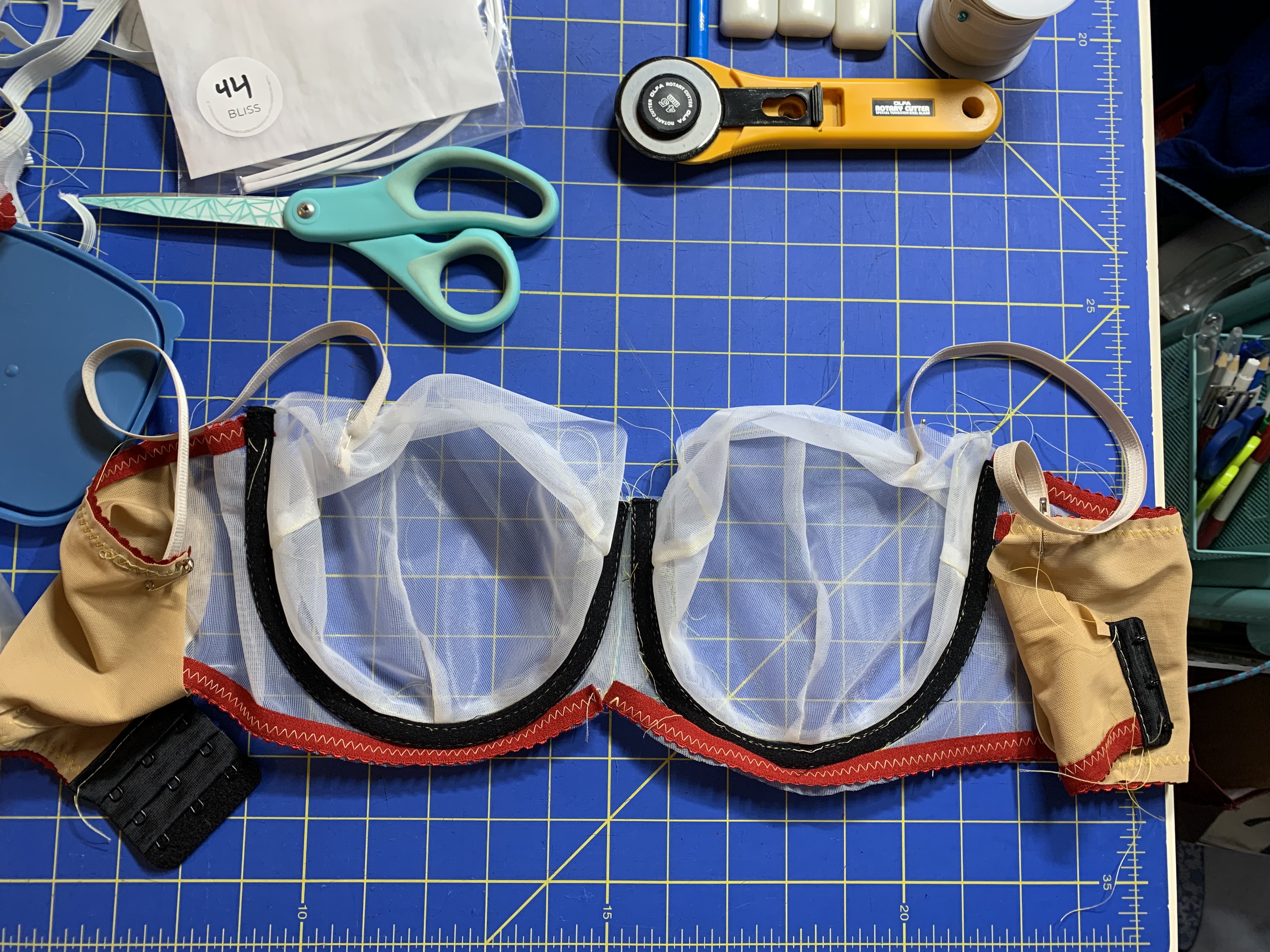
The cups aren’t perfect but they are really quite good and the wire line for the 44 Vertical wire looks much more reasonable for my body shape and size than it did in the 38 Vertical Long, which was very narrow. It was also really clear to see that I have a longer upper cup than lower cup when all this time I thought it was the opposite! Ultimately I don’t think it would have impacted the original volume issue because of how the Porcelynne draft method accounts for the overall cup length calculation, but it is good to note moving forward.
I was really happy with how this sample had turned out, but during the process of making this, I had also decided to order the Bra-makers Manual Volumes 1 & Bra-makers Manual Volume 2 because I was really curious to compare the process between these books, but also because everyone has said these are great resources for anyone who likes to sew bras.

I will provide a bit more of a general book review for all of these at the end of this post, but for now I will say that if you are specifically interested in Beverly Johnson’s self-drafting method it is contained in Volume 2. Because I’m curious and because I was finding a decent level of success with the Porcelynne method by the time these books arrived, I decided I wanted to try making a second self-draft to compare the techniques of the two books. You know. For science.
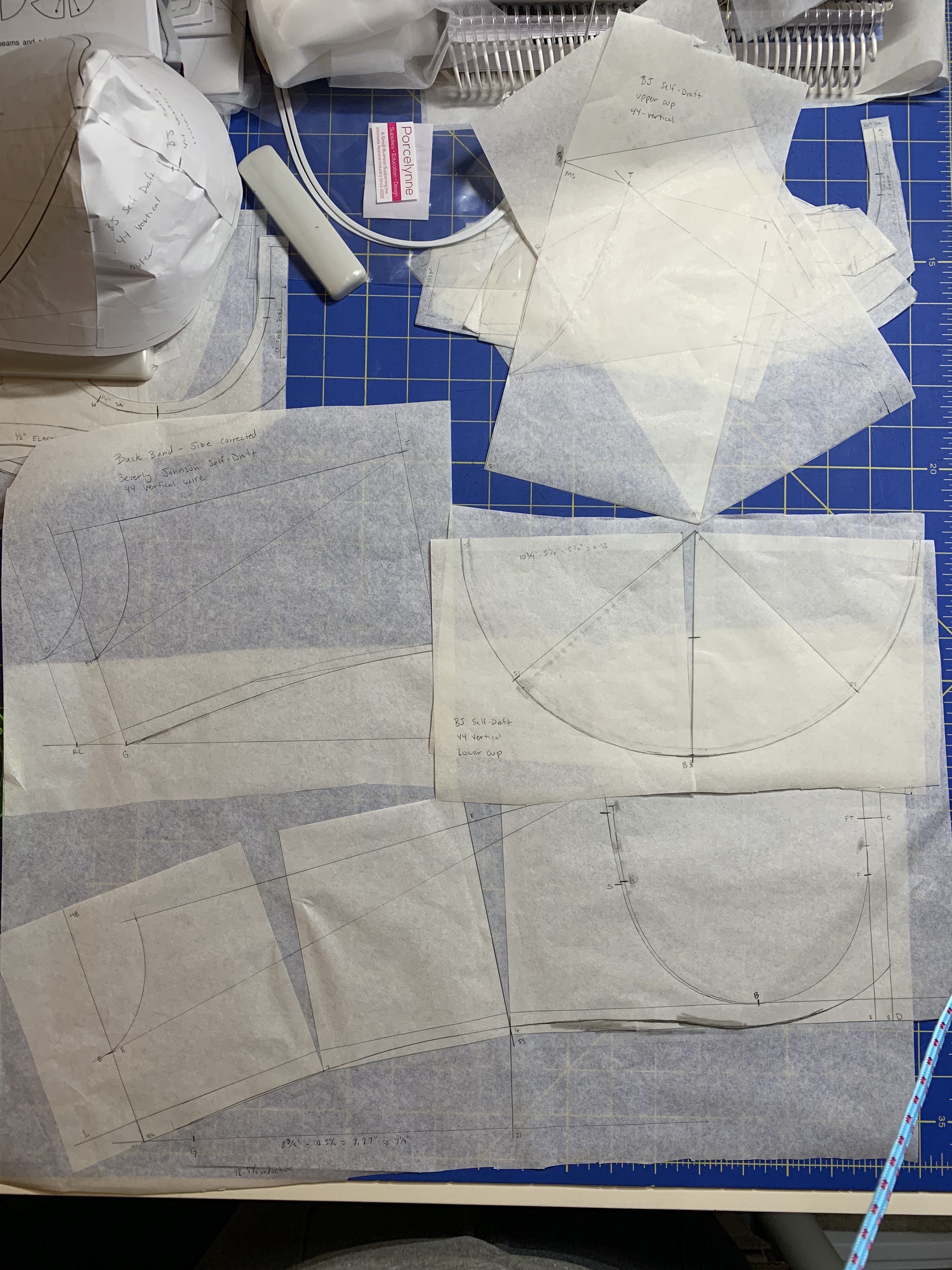

In some ways, both of these manuals have very similar methods in that you use the wire to draft the cradle and band and then use a circle and information about the cup volume and wire line to draft the cups. However, the measurements needed for each method are very different, and some of the steps and assumptions made during the drafting process produced drastically different results.
Below you can see the difference between the Porcelynne self drafted pattern (with the final volume adjusted cup patterns) vs. the first draft from the Bra-maker’s Manual:
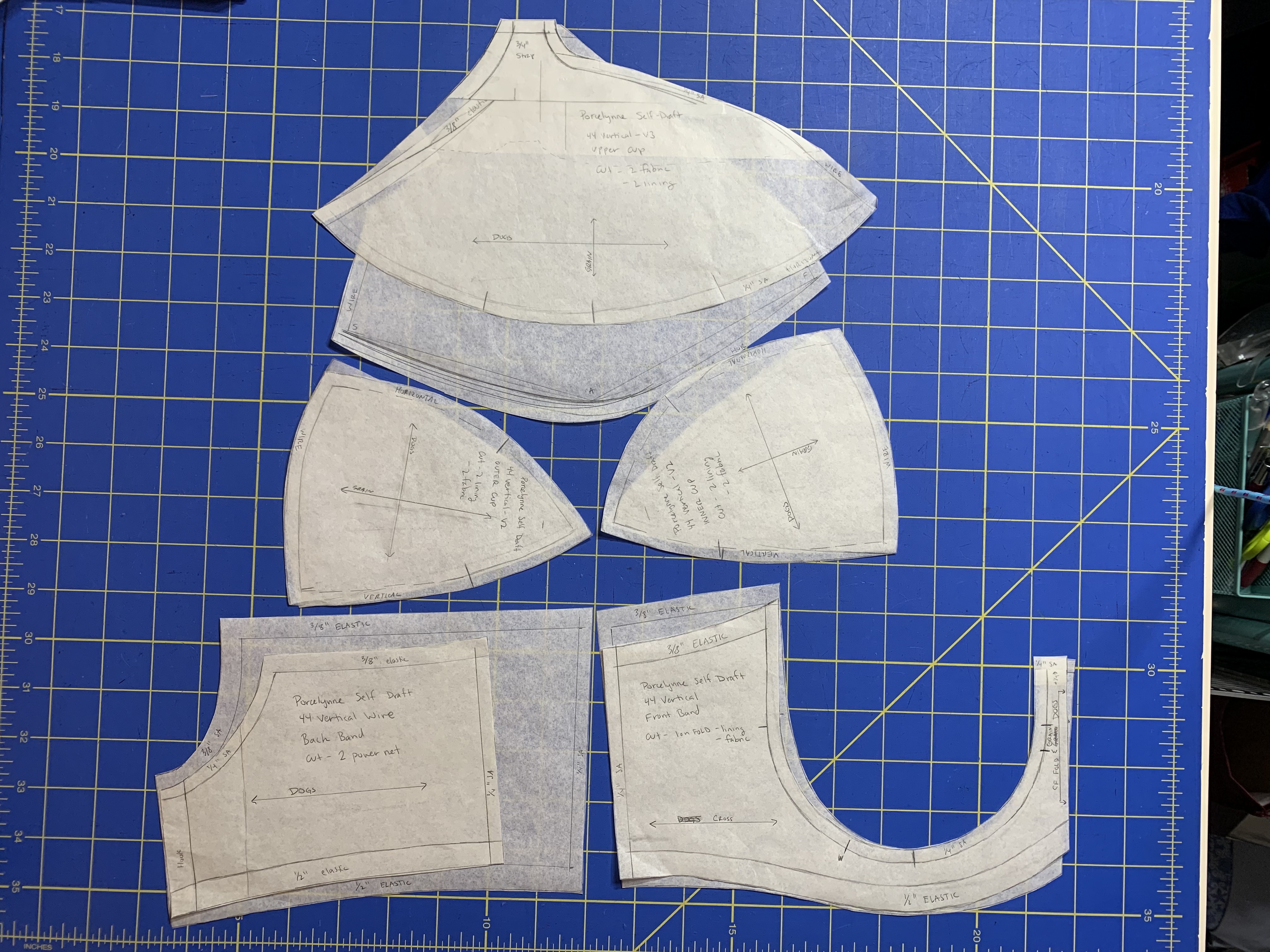
Right away the biggest differences are where the cup volume is located and also the size of the back band pattern piece.
Similarly, I compared the Bra-makers Manual draft vs. the Cashmerette Willowdale pattern I had used for my most recent (and most successful) bras:
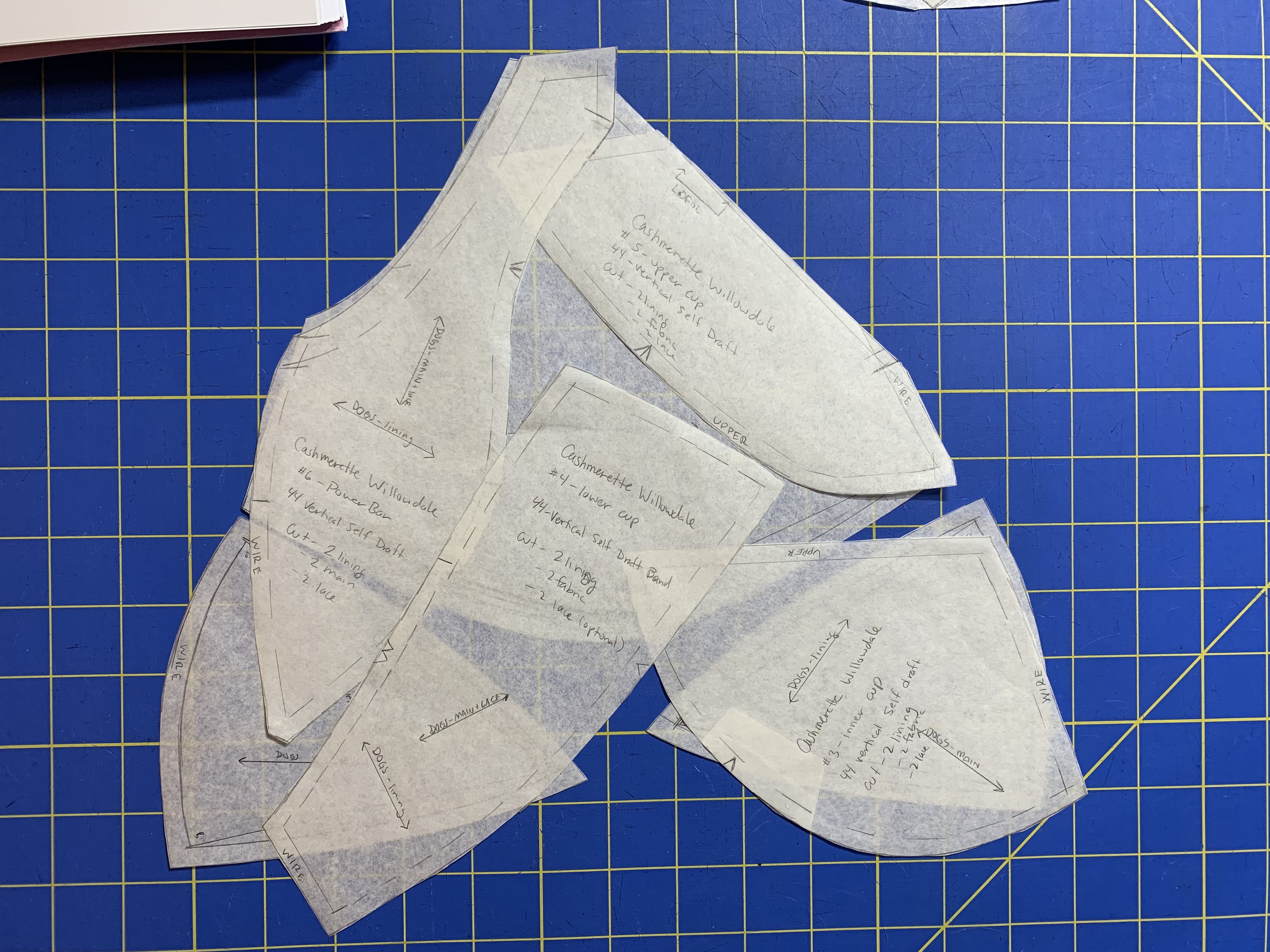

From these comparisons I noticed a few things. (1) The cup volume from the Bra-makers Manual initial draft was actually pretty good. This was opposite to the Porcelynne method, where the cup volume was very small because I use a much smaller wire size relative to my cup volume and there isn’t really a good way to take that into account with that technique. (2) The band draft from the Bra-makers Manual actually seemed pretty big, especially the back band. I think perhaps Beverly Johnson doesn’t use quite as much stretch reduction standard as the other method (in both cases I used the suggested percent reduction), and the band is definitely a bit taller than what I had gotten from the Porcelynne method, though similar to the Willowdale, which I actually rather liked that aspect of the pattern.
Because I have really found it helpful to visualize the cup shapes with the paper samples, I made a paper cup to see how it would look. The result was very pointy:


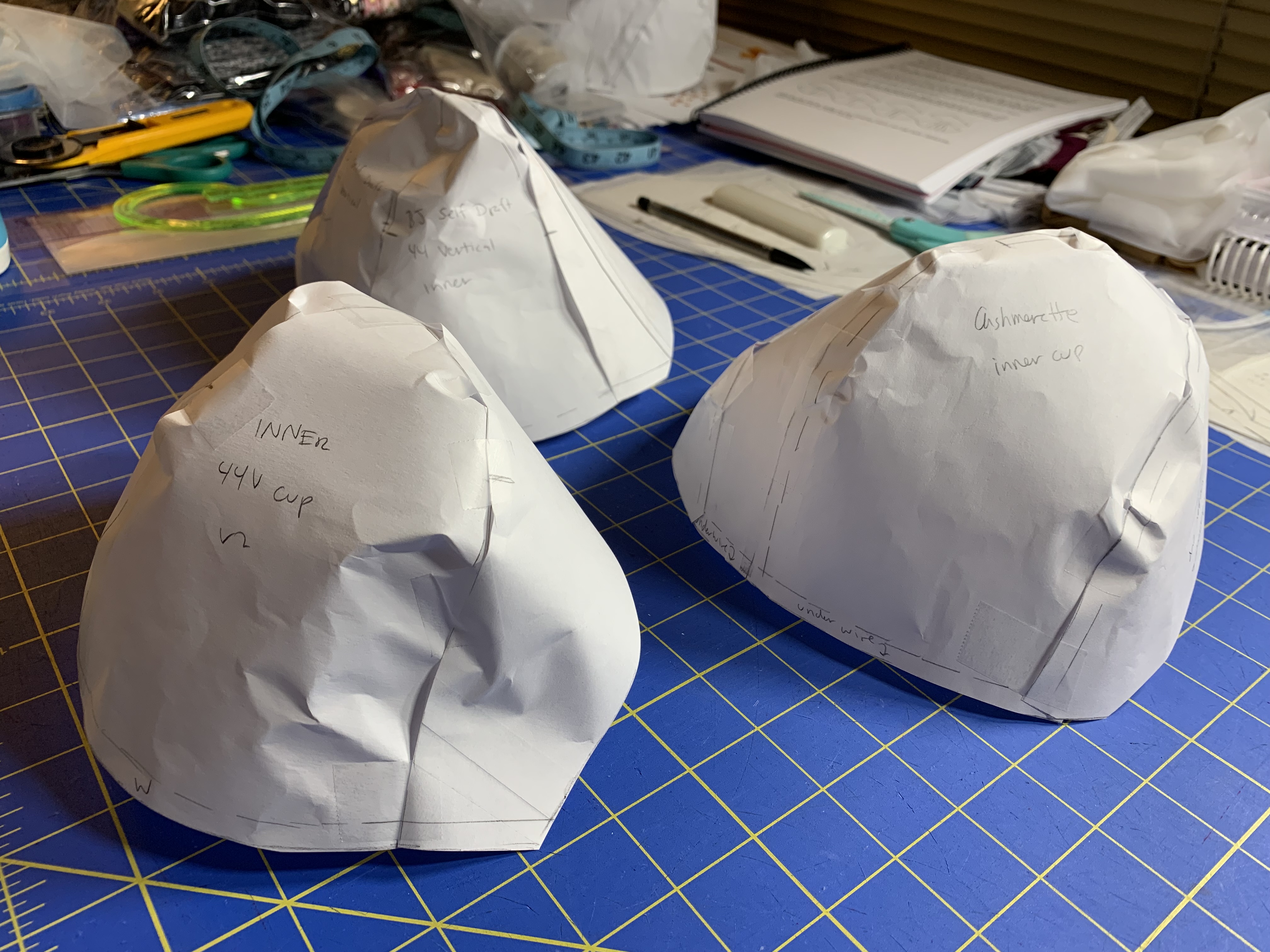
In the above images the Bra-makers Manual draft is to the left, the Porcelynne draft is towards the bottom, and the Willowdale cup is towards the upper right. It is really clear to see how peaked the Bra-makers Manual draft is, especially in direct comparison to the others. Happily, one of the best features of the manuals is the ample directions in how to adjust the pattern for different fit issues, so I “rounded the crown” and adjusted for my “pigeon breast” chest shape by moving the apex towards the inner cup. It produced a much better result (right below):

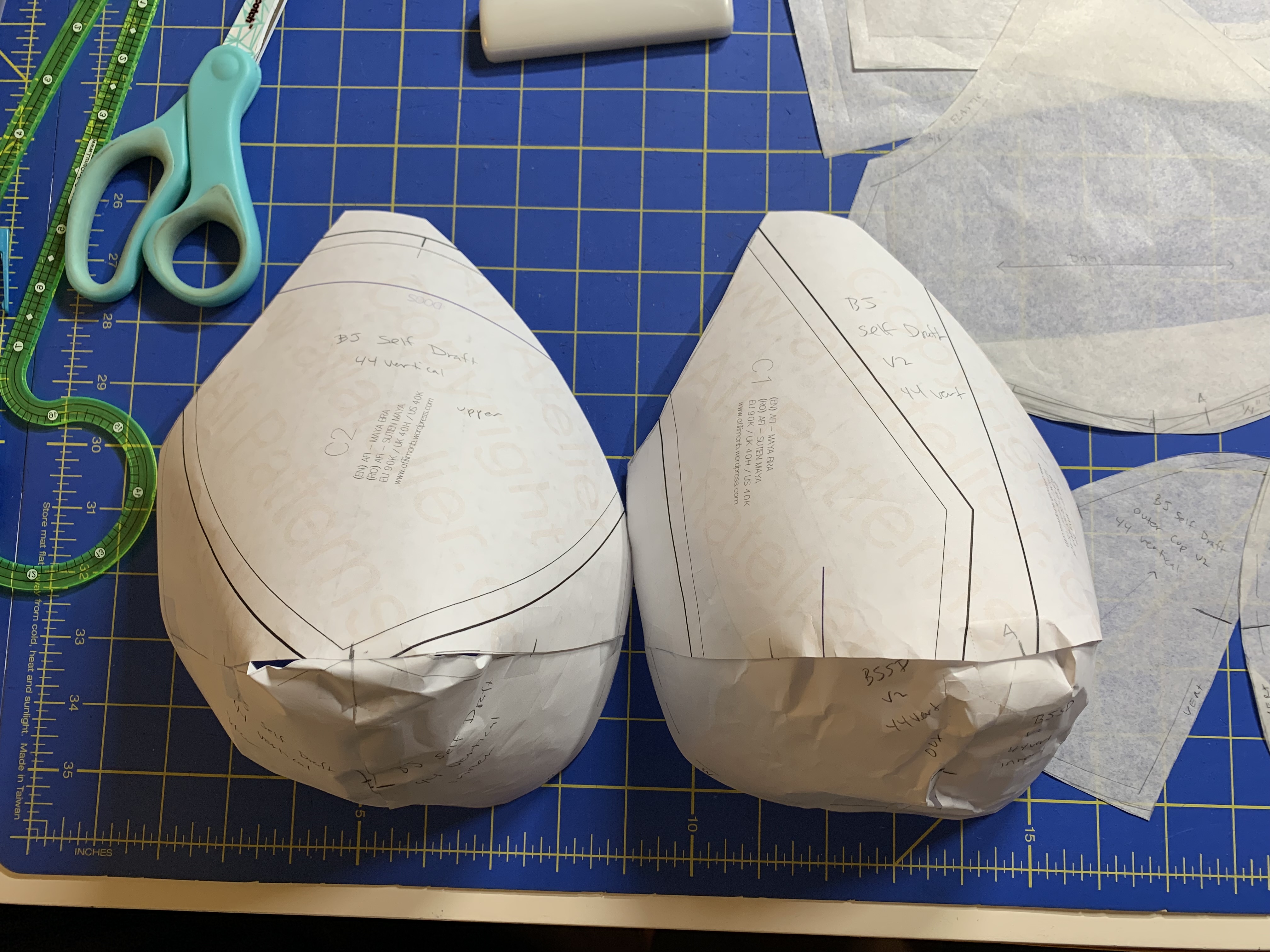

With this I felt ready for a mock up of this new pattern. I decided to test two different cups – the self draft on the left and the Willowdale adjusted for the new wire line on the right:
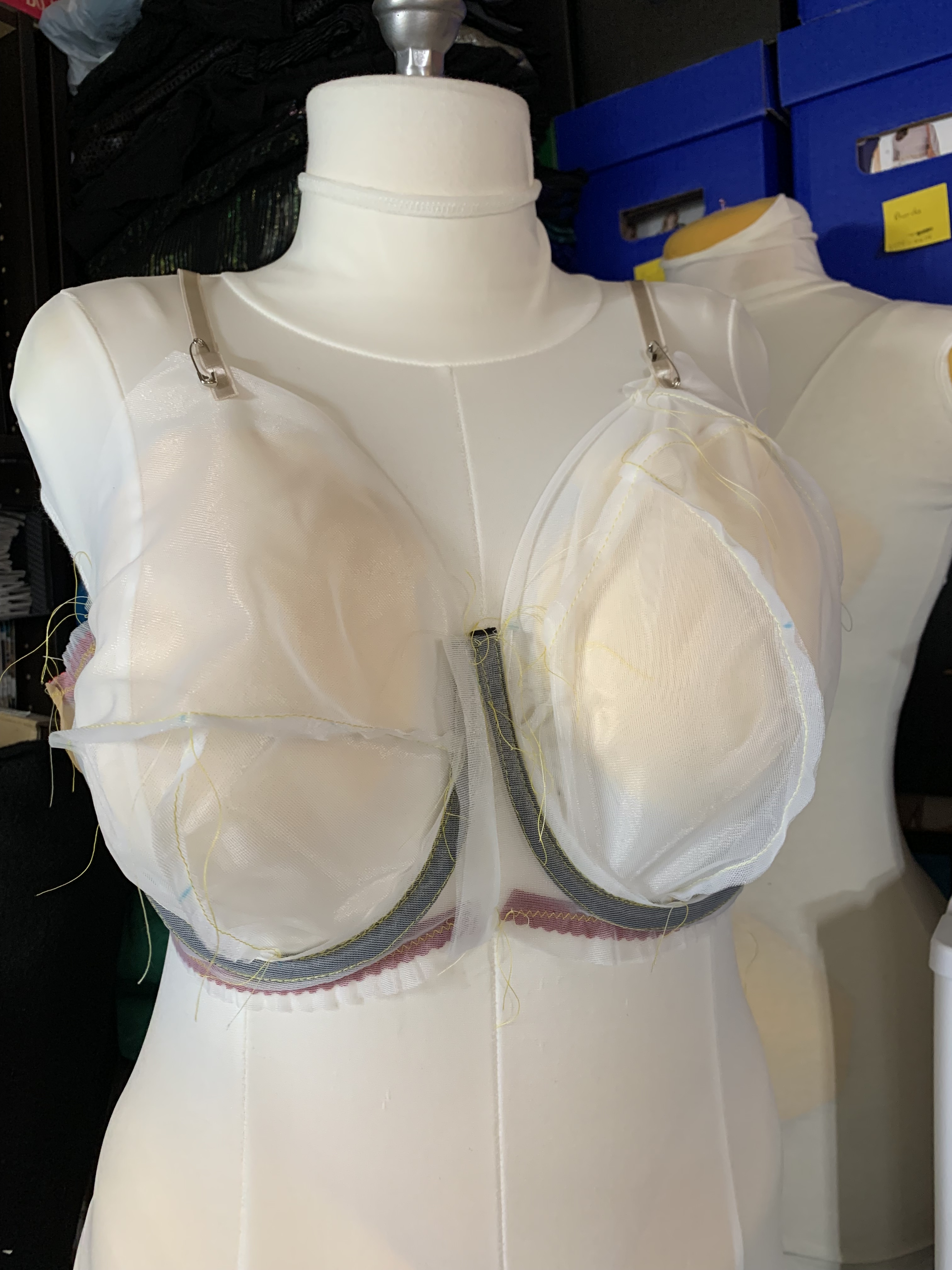

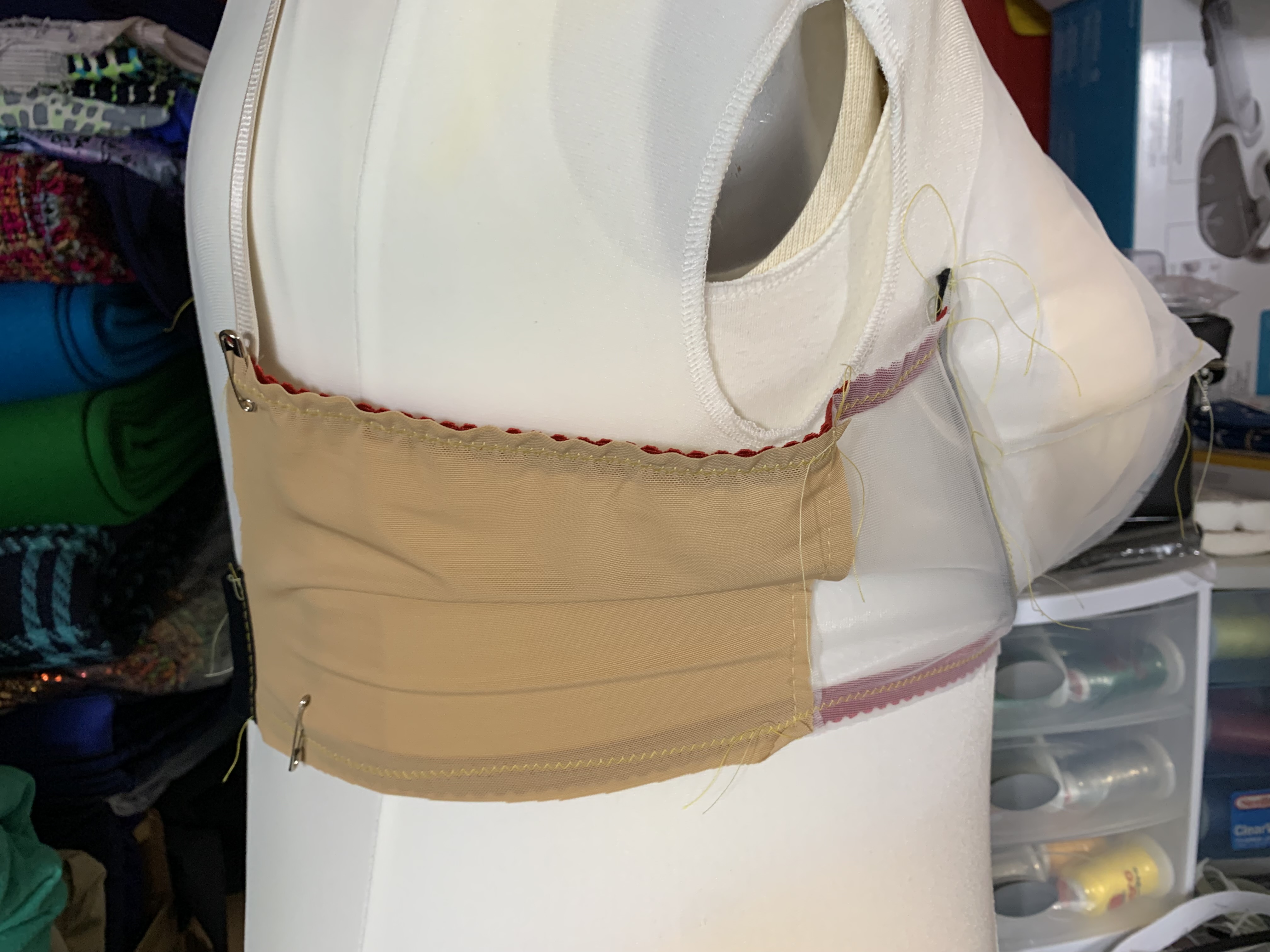

The cups actually fit pretty well! However, the band had a lot of fit issues, especially in the back. Interestingly, I think a lot of the fit issues I see in the self draft were issues I had with the Pin-up Girls patterns to begin with; the cups tend to be wide and pointy, and the back band tended to be a bit long for a given size, and I had a lot of gaping at the side seams.
So at this point I feel like my curiosity has been satisfied. I can say that, for me, the Porcelynne method gave a much better band draft, but the Bra-makers Manual gave a much better cup draft before making any changes, despite its pointedness. I think this has to do with the measurements taken – the Porcelynne method only takes upper, full, and lower chest measurements into account along with the wire size to draft the cups. The Beverly Johnson method takes a lot more measurements around the actual breast itself, which does a much better job of creating decent cup volume if it is not proportional to the wire size (as is my case). After making pattern modifications though, I do think I prefer the shape of the Porcelynne cup. Granted, for either case I would at this point still need to make a lot of style line changes and likely add a power bar to get the type of support I need, but was interesting to see how relatively similar the cups were after completing the drafts. As for the band, at this point I think I am going to just move forward with the Porcelynne draft because it really was an excellent fit right away, though if I need to make any alterations (such as adding a drop to the hook area or adding more coverage in the back band) I would probably refer to the Bra-makers Manuals for instructions.
So, which of these books would I recommend? I will say, now that I have all three of these manuals I am very glad to have all of them. I think they each serve a different niche. If you are only interested in self-drafting a bra pattern, I do think the Porcelynne book is better. The majority of the manual is dedicated to drafting a pattern using paper and computer techniques, and also how to make different cup designs using a sloper. I also think the results I got in terms of fit were definitely “scary accurate”, at least for the band. I will say that in terms of adjusting the cups to fit, I did have to rely quite a bit on other resources, and actually had a bit of a lightbulb moment reading through the fit discussions in the Bra-makers Manual Volume 1, so if the goal is just to have a resource for how to adjust commercial patterns, I think the Beverly Johnson books are better. To me, the Bra-makers Manual Volume 1 is a great resource for general bra sewing and common fit adjustments, and it is the only book of the three that discusses how to clone an existing bra to make a pattern. It has a lot of the same information that is available in the basic bras sewing and construction class on Craftsy and some of the information given in some of the the more advanced classes. However, given how many times Craftsy has been sold, re-branded, and sold again in the past decade, I am happy to have a lot of the information in a book I can continue to reference if the platform ever goes down. And, honestly, given how bad the current platform’s navigation and search is, going to the book for quick references is probably a lot faster at this point anyway. If you are a fairly advanced or competent bra sewer, I don’t think the first volume has a ton of new information that isn’t available elsewhere, but I am happy to have it as a reference in my library because it isn’t subject to the whims of the internet keeping it available as a resource. Conversely, the Bra-makers Manual Volume 2 is where it’s at if you want more advanced and detailed bra making information. The second manual deals with more complex fitting issues and more complex construction techniques such as lace and foam. Many of these topics are covered in the more advanced Craftsy classes, but not all of them. This is also the manual that contains information on how to draft a bra pattern. In some sense if you wanted more of an all-in-one book, I think the second volume would be a great option. I think this would be especially true if you fit really well into the PUG patterns to begin with, as the drafting techniques in this book create a very similar fit. So, in general I think all of these books compliment each other and serve different purposes. I’m happy I have all of them in my reference library at this point and I have enjoyed reading through all of them. I have learned a lot about pattern drafting and fitting, and know I have some great resources if I want to work on adjusting the styles or creating new styles of self-drafted cups.
So, now that I’ve gotten to a relative end-point of the drafting journey, where to from here? For now I’m going to abandon the Bra-makers Manual draft and move forward with testing the Porcelynne draft since it was a much better initial fit. I am currently working on making a wearable bra blending the self drafted Porcelynne band with the Willowdale cups for the 44 Vertical (Bliss) wire. While I could use the Porcelynne self drafted cups as a proof of concept, I still prefer the shape and look of the Willowdale, and I want to make a bra I want to wear. With any luck I will be able to finish this project and report back on the fit results before the end of the month. If this experiment is successful (and I really hope it is!) then I think I will be ready to move on to more fun and interesting projects soon. I’m also dying to try some different bra patterns and test out new cup styles. If I can get a library of cup options to fit in my self drafted band (or use the self drafted band to alter the patterns for fit) I think that would be really exciting to move forward with more creative projects in terms of adjusting for style and fabrication rather than fit. Next month life starts to get really busy again, so I don’t know how much time I will have for sewing projects, but I’m hoping I can sew at least a little each week, especially if I’m ready to move on to the next phase of my bra sewing adventures!
 Doctor T Designs
I love your deep dive into the bra making! This has helped me a lot.
LikeLiked by 1 person
I’m loving the deep diving, too! Thank you so much for sharing. Susan
LikeLiked by 1 person
Well Done for getting to the point where you can start to make use of all this for your own designing 👍
LikeLiked by 1 person